Papaveraceae family
Features:
- It is an annual cultivated plant.
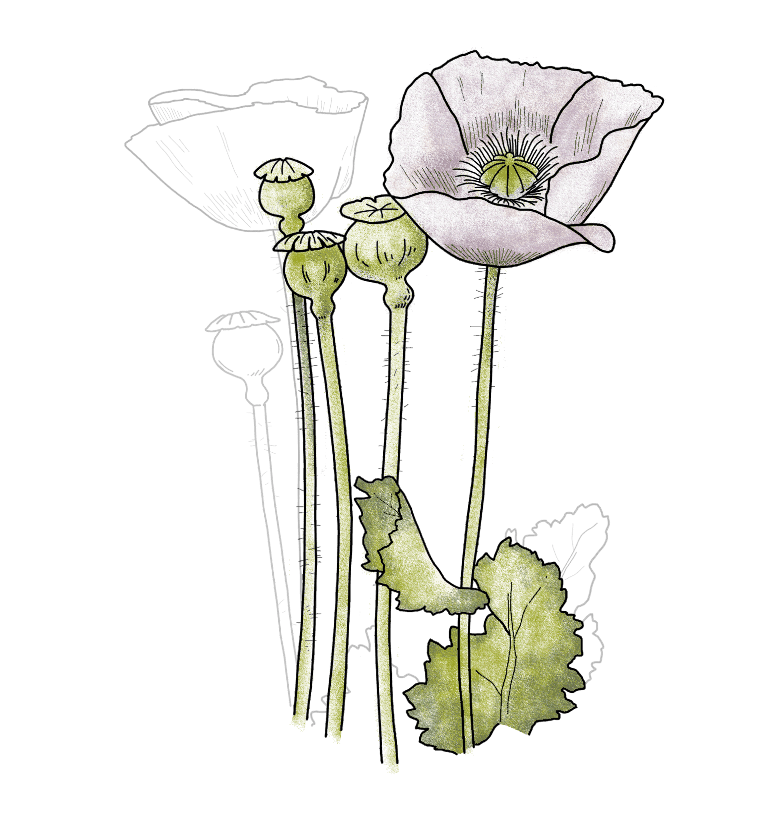
- Its stems are 50–150 cm tall, varying from species to species, sparsely or distinctly branched, ashy, and bluish-green. The lower leaves are petiolate (have a stalk), and the upper ones are sessile (without a petiole) and amplexicaul (with the base dilated and clasping the stem). Their shape is variable: oblong-ovate, their edges unevenly incised or lobed.
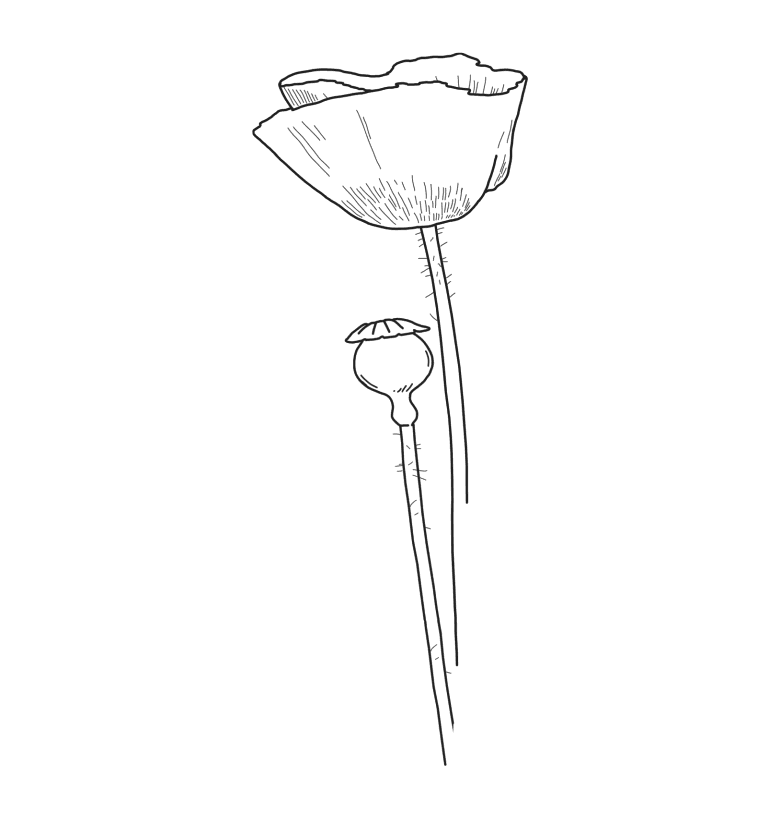
- The flowers are solitary, and the buds are pendant, but rise when they open. In the morning, when the petals open, the two boat-shaped sepals fall off. The petals are variable in colour: there are white, pink, red, and purple cultivars, with a darker spot at the base of the petals.
- The fruit is a capsule with a single multi-septate cavity, the shape of which also it can be distinguished depending on the variety: almost round, oval, pear-shaped, elongated like a barrel, or the widest in the middle. At the top of the capsule is the permanent, crown-shaped stigma, the number of its lobes corresponding to the number of carpels or septate compartments inside the fruit.
Habitat: The opium poppy does not occur in the wild. It has been grown since ancient times for food, oil, and as a medicinal herb.
Medicinal use:
The milky poppy sap contains more than 35 isoquinoline alkaloids, its main component being morphine, codeine, thebaine, papaverine, and noscapine (narcotine). Opium is the raw material of pure alkaloids utilized in various formulations. Morphine has analgesic and anaesthetic effects, and it is highly addictive. Codeine alone has no analgesic effect, but it has a potentiating effect on other analgesics. Noscapine is powerful antitussive medicine. The papaverine relaxes smooth muscles, alleviating spasms in the gastrointestinal tract, biliary tract, and urinary tract.
Warning:
Its cultivation is allowed only under strict legal conditions and with a special permit.
Curiosities:
The opium poppy was the first anaesthetic in ancient healing. It became more known to mankind in the 19th century, when they used it to produce morphine – named after the son of the god of dreams, Morpheus – a much more effective analgesic than opium.