Primrose family (Primulaceae)
Features:
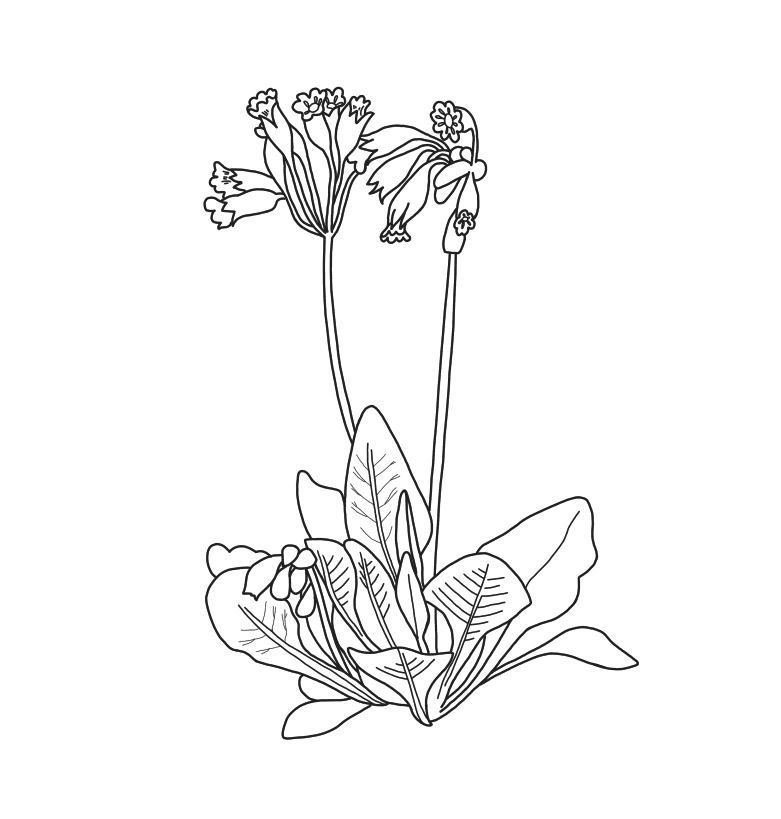
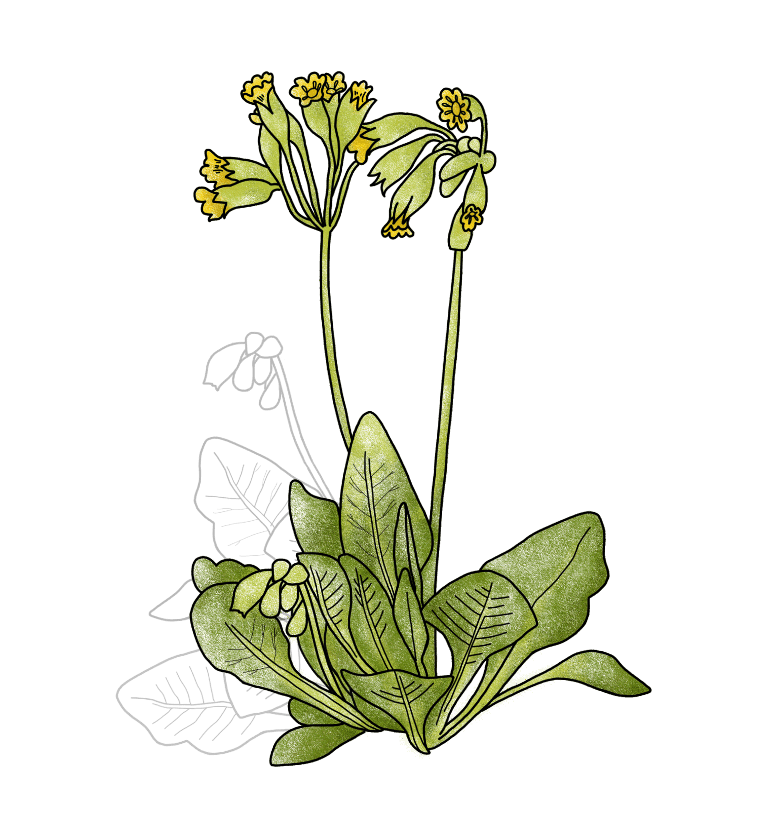
- It is a perennial plant with a cylindrical rhizome about 10 cm long and 0.5 cm thick.
- Its leaves form a basal rosette, are oval or round, with a blunt apex, crenate edges, slightly blistered and rugose surface, and winged petiole. The young leaves are bent backward along the main nerve.
- The flowers form a simple umbel at the top of the leafless peduncle, which can reach a length of 30 cm. The flowers are cernuous, with a slightly swollen calyx, 1.5–2 cm long, consisting of 5 light yellowish-green sepals. The tubular corolla formed by the fusion of 5 sepals has five orange spots or a ring towards the base; it has five stamens attached to the tubular corolla; the superior ovary (seed coat) is round. The capsule grows inside the persistent calyx.
Habitat: It grows in grassy places, forest edges, and clearings, from hilly to mountainous areas in most parts of Europe and Asia.
Medicinal use:
All parts of the plant, especially its rooted rhizome, contain saponins. The usual saponin content of the rhizome is 10%. The flowers have a lower saponin content, but their yellow flavonoid pigments make them a so-called beauty-care tea. The rhizome is used as an expectorant in the form of a decoction in bronchitis and other respiratory tract infections. Effect: mucolytic, used in respiratory tract inflammations, rhinitis.