Mallow family (Malvaceae)
Features:
- Its roots are 10-30 cm long and 2-3 cm thick.
- Its stem rises to a hight of 80-120 cm.
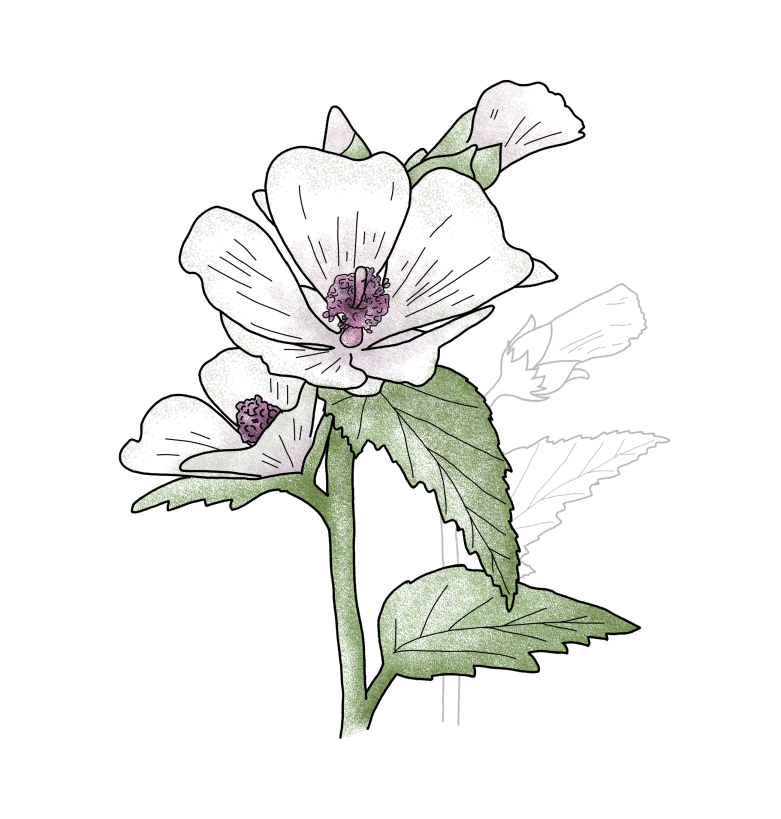
- Its greyish-green leaves are serrated and hairy.
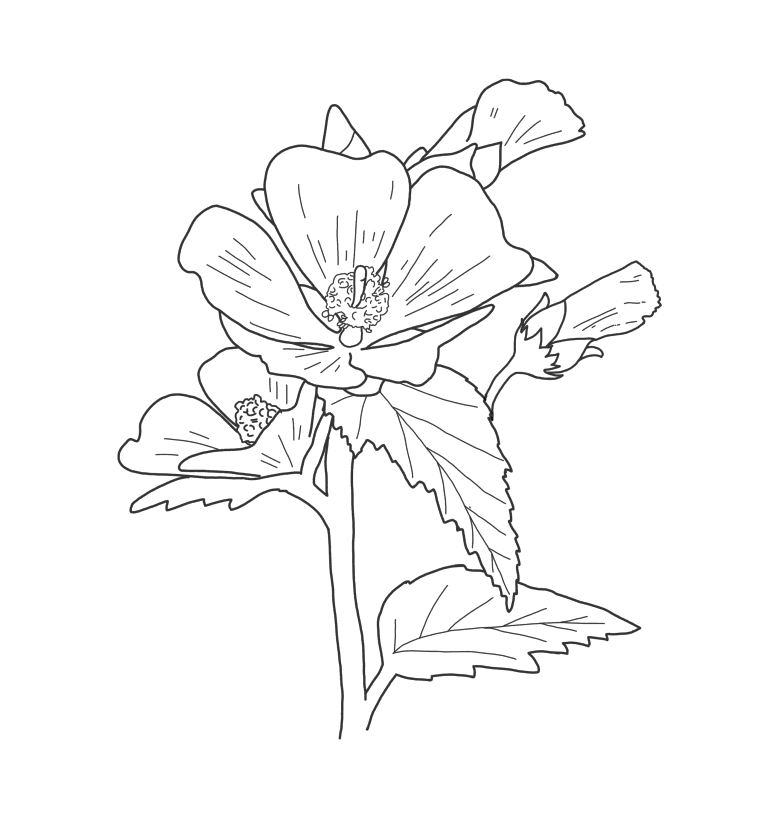
- Its flowers are white or pale pink.
- The seed coat is divided into segments, it is flat, hairy, and orbicular as mallow.
Habitat: Wet areas, river floodplains, or wet meadows.
Medicinal use:
Nearly all its parts are used for medicinal purposes, including leaves, flowers, and roots.
The marshmallow is used as a demulcent, diuretic, emollient, and wound healing herb in inflammatory diseases of the mouth and pharynx, to reduce coughs and in cases of inflammatory diseases of the digestive organs.
It increases milk secretion and soothes the bronchi.
Domestic use:
In the folk medicine, the leaves are used in form of compression to treat dermatitis.
The cold tea prepared from its roots is used in folk medicine to treat sore throats and coughs. It also has diuretic, wound healing, and emollient effects.
Curiosities:
Marshmallow roots should be used as soon as possible after harvesting, because they mould easily.
Several species of this family are grown in gardens or as ornamental plants in homes. Examples include hollyhock (alcea rosea), and China rose – hibiscus rosa-sinensis, whose English and Romanian names refer to China.